
Your child’s dinner tonight looks a lot like dinner last night, and the night before that. Chicken nuggets. Plain pasta. Maybe a specific brand of crackers. If your child’s accepted foods have narrowed down to a small, predictable rotation, having an actual ARFID food list, a written record of what your child reliably eats, can make meals feel a lot more manageable, even before anything else changes.
As a registered dietitian who specializes in extreme picky eating and ARFID (Avoidant Restrictive Food Intake Disorder), I work with families every week who are trying to keep mealtimes calm while also worrying about whether their child is getting enough variety and nutrition. Building a food list is one of the simplest, most concrete places to start. It’s not a fix for ARFID on its own. ARFID is a real eating disorder, more than typical picky eating, and a list of safe foods doesn’t replace treatment when treatment is needed. But it’s a genuinely useful tool, and this post is a practical guide to building one, understanding what it can and can’t tell you, and figuring out where to go from there.
Which Foods Can Be Included on an ARFID Food List
An ARFID food list is exactly what it sounds like: a record of the foods your child currently and reliably eats. That sounds simple, but writing it down does real work. It helps you identify patterns in your child’s eating preferences, sensory triggers, and any nutritional gaps you might be missing day to day, because it’s easy to lose track of what’s actually on rotation when you’re in the thick of it.
An ARFID food list will include a child’s safe foods. These foods aren’t “safe” or “unsafe” in a traffic light sense, they’re simply foods your child’s system can currently tolerate in terms of taste, texture, look, and smell.
A good list also surfaces opportunities for gradual expansion. When you can see your child’s accepted foods laid out together, similarities start to jump out. Maybe every safe food is crunchy. Maybe everything beige or white gets accepted and everything green gets refused. That pattern becomes your starting point, not a wish list of foods you’d like your child to eat, but a foundation built from what’s already working.
The ARFID Food List
There’s no single food list that works for every child with ARFID, because every child’s safe foods, sensory preferences, and nutritional needs are different. Still, most families’ lists cluster around a few familiar categories.
Grains and Starches
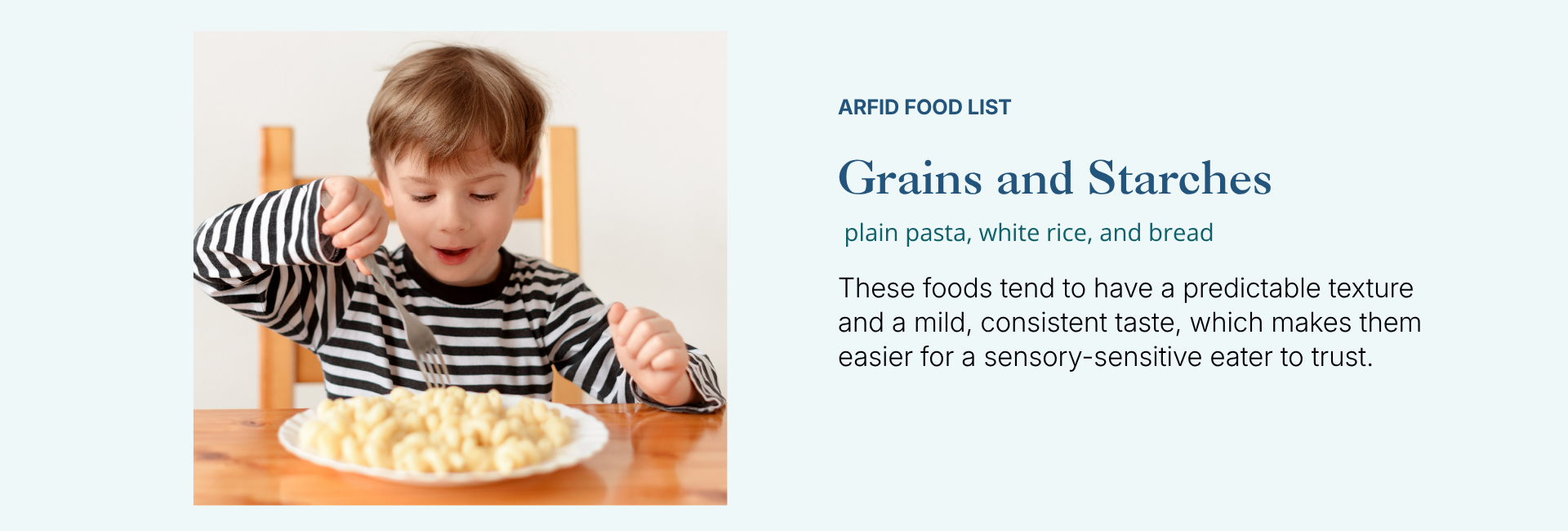
Foods like crackers, plain pasta, white rice, and bread show up on almost every family’s list. They tend to have a predictable texture and a mild, consistent taste, which makes them easier for a sensory-sensitive eater to trust. Note your child’s specific preparation preferences. There might be more variety or room for variety than you realize.
Proteins

Chicken nuggets are the classic – and often only – example, and for good reason: they’re crunchy on the outside, soft and uniform on the inside, and taste the same every time. Other common safe proteins include specific brands of yogurt, cheese, or a single preparation of eggs.
Fruits and Vegetables

These tend to be the shortest category on most lists, and that’s common, not a failure on your part. When fruits or vegetables do make the list, they’re often served in one specific way, like apple slices with the skin removed or mixed with other foods like smoothies.
Snack and Packaged Foods
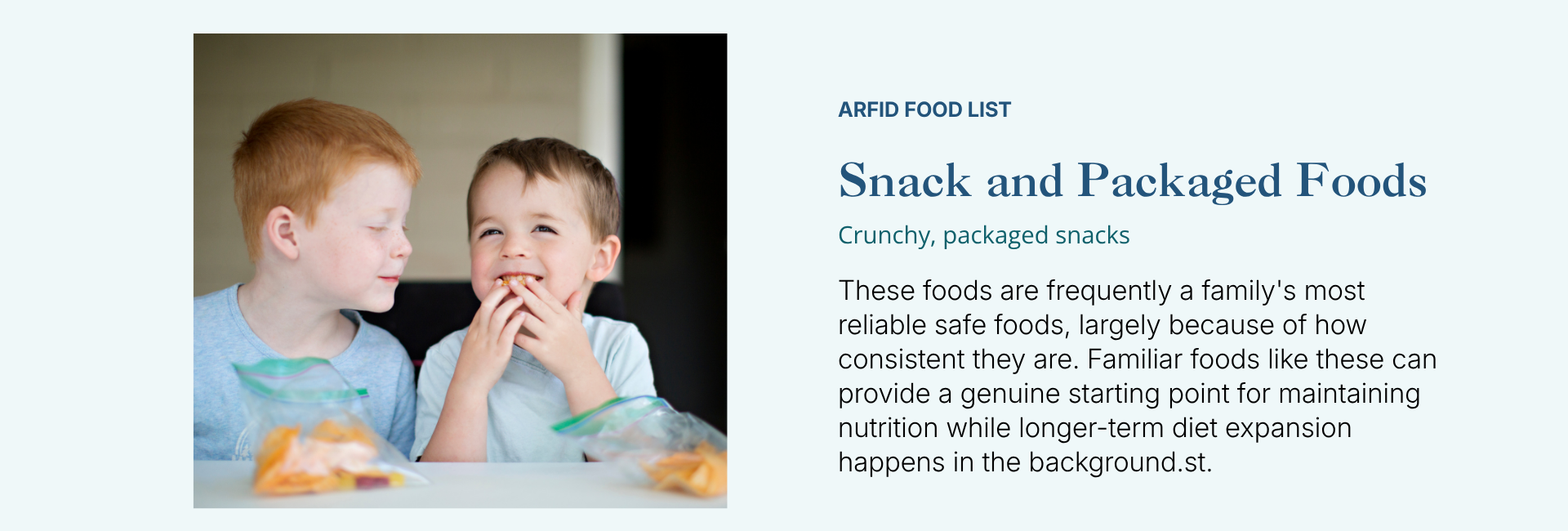
Crunchy, packaged snacks are frequently a family’s most reliable safe foods, largely because of how consistent they are. Familiar foods like these can provide a genuine starting point for maintaining nutrition while longer-term diet expansion happens in the background.
How to Build an ARFID Food List
Building your own list is straightforward, but it works best when it’s specific rather than general.
Track What Your Child Actually Eats for a Week
Write down every food your child eats without a fight, including snacks, in the exact form they’ll accept it. “Chicken nuggets” and “this brand of chicken nuggets in this specific shape” are two very different data points.
Note the Textures and Patterns
Look for what the accepted foods have in common: texture, temperature, color, brand, or shape. This is often where families notice for the first time that their child isn’t being random or difficult; there’s usually a consistent sensory thread running through the whole list.
Identify Near-Miss Foods
Once you can see the pattern, look for foods that share one or two qualities with an already-accepted food but aren’t quite the same. If your child eats crackers, a different cracker with a similar texture is a much smaller ask than a vegetable. This is the basis of food chaining, using small, sensory-similar steps to gently expand a child’s range of foods over time.

Involve Your Child Without Pressure
Kids can help build the list itself. Ask what they like about a safe food (the crunch, the color, the shape) without turning it into a conversation about what they should eat next. This keeps the exercise focused on understanding, not correcting, and it tends to reduce anxiety around the whole process, both for your child and for you. Other family members can help too, simply by noticing and reporting what your child actually eats in different settings, like at a grandparent’s house or at school, where habits sometimes look different than they do at your own table.
Revisit and Update It Regularly
Safe foods change. A food that was reliable last month might get dropped this month, and that’s normal for kids with ARFID, not a sign that something’s gone wrong. Update the list every few weeks rather than treating it as fixed.
Can an ARFID Food List Meet Nutritional Needs?
Sometimes, at least for a while. When paired with supports, like a multivitamin, or in some cases oral nutritional supplements, or when it includes enough nutritional powerhouses, an ARFID food list can meet a child’s needs even when the range of foods is narrow. This is something to work through with a dietitian, because every child has unique needs.
Other times, the foods a child eats are not enough to support their nutritional needs. If your child is suffering from ARFID that’s led to significant weight loss, slowed growth, or clear nutritional deficiency, that’s a sign their eating challenges need to be paired with professional treatment options rather than managed at home alone. This is true for people with ARFID at any age, not just young children.
If you’re noticing gaps that worry you, or your child is eating an increasingly small amount at meals, it’s worth bringing your list to your child’s doctor or a dietitian familiar with ARFID. You don’t need to have it all figured out first.
For a fuller picture of what’s going on with your child’s eating, what is ARFID and 3 types of ARFID are good starting points, and if sensory reactions seem to be driving your child’s food choices, sensory issues with food walks through what that can look like and why it happens. If you’re weighing whether a feeding therapist could help, what is food therapy for kids explains what that treatment option actually involves.
Where to Go From Here
An ARFID food list won’t solve ARFID, but it gives you and any provider you work with a clear, honest starting point instead of a vague sense that “they only eat a few things.” It replaces guesswork with a real record, and that record is often the first step toward calmer meals and, eventually, a wider range of foods.
If you’re ready for more structured support in expanding what your family member eats, using a no-pressure approach focused on food exposures and sensory exploration tailored to your child’s own readiness, my 3 Steps to Eating guide is a free place to start.


0 Comments