“I’m tired, frustrated, and I don’t know if this will ever change or if we just did everything wrong.”
“I just need him to get the calories, but I feel like I’m making it worse.”
“I feel sh*tty for [my child] and myself for not getting help sooner.”
“I’ve been devastated that I can’t feed her. It felt like something I should be able to do.”
I’m sure you can relate to the feelings above – the guilt, shame, and blame that can come with having a child who struggles to eat.
And I’m sure at least one person has told you that it’s not your fault.
But still. Here you are. Feeling like it’s All. Your. Fault.
You might play a small role in your child’s eating. Every parent does. The truth, though, is that there are SO many reasons why a child might struggle with eating.
When you can realize (and truly believe) that and start to let go of guilt with your child’s eating, eating starts to go better (and you start to feel a lot better, too).
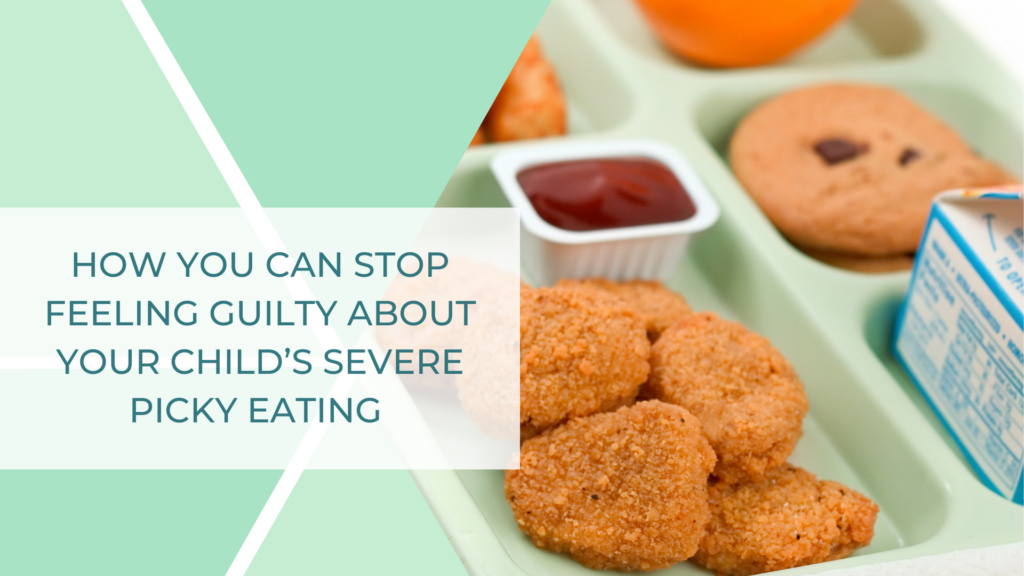
3 Ways to Stop Feeling Guilty About Your Child’s Severe Picky Eating
Learn your new mantra
Repeat after me: I did not cause my child’s eating challenges.
The way your child eats is not a reflection of you as a parent.
If your child struggled to learn to read or was late to walk, you wouldn’t feel guilty and think that you’re the cause.
It’s the same with eating.
There are so many factors that go into what and how a child eats. The first part of helping them is accepting this.

Don’t look around
One of the moms in the Eating with Ease Program recently shared that she spiraled wherever she spent time with her sister’s family.
Her nieces ate “perfectly” – everything put in front of them, whatever the rest of the family ate.
Her daughter? She struggled to even sit down to a family meal.
A few weeks into the program, after we worked on coming to terms with the reality that every child is at a different point with their eating (and that that is okay), she shared that she was no longer in this place –
“There’s been a huge difference in my mindset. I feel a lot lighter. I’m no longer blaming myself, feeling guilty, comparing her to others and seeing all the things she can’t do yet. I’m feeling so much better and it’s freed my daughter of that pressure, too.”
How or what your child eats is not a reflection of you, whether they eat five foods, fifteen, or fifty.
Adjust the focus
As a mom, I get it. I know you worry about your child’s wellbeing from every angle. I worry that my son’s had too much dairy or gone the whole day without eating a vegetable.
It’s natural for us to worry. Since Day One we’re told our kid’s nutrition and wellbeing is our responsibility. But I’ve found we worry more than we need to.
Instead of looking at what they eat in a single day, look at their intake over the course of a week.
Remember that kids are resilient. Your child can get the nutrition they need on a limited diet and often there’s no harm in offering a multivitamin.
When feeding doesn’t go well, it is natural to blame yourself. Remember that there are SO many reasons why a child might struggle to eat. You are just one small factor – and the only one with the ability to help them.
Helping your child improve their eating starts with coming to term with their struggles and the reality of what’s causing them. You do not need to feel responsible for your child’s eating
Seeing your child learn to eat a variety of foods will ease your guilty feelings. In the meantime, if their eating isn’t going in the direction you’d like, consider getting support. Curious about what getting support for your child’s eating looks like? Send me an email and I can chat it through with you.


0 Comments