

Mealtime distractions tend to have a bad reputation. They’re associated with mindless and overeating. But you and your child probably have a very legitimate reason – or two or three – for incorporating distractions like TV, tablets, or toys at the table.
Learn more about why mealtime distractions are popular and why some are adamantly against them in this post.
Regardless of why and how mealtime distractions gained a seat at your dinner table, you might be ready to try distraction-free meals. If that sounds good, this guide is for you.
You can try the distraction-free tips at all meals or start small with one meal per day. Follow the mealtime management tips to make meals comfortable and reasonable to kids who struggle to eat and then pick which distraction-free method is best for you.
Mealtime Management Tips for Picky Eaters
-
Keep meals short and to the point.
-
Focus on just eating for now. As your child becomes more comfortable eating and sitting at the table distraction-free you can extend mealtimes.
-
-
Include more of your child’s preferred foods.
-
Non-preferred and new foods challenge your child. Keep the discomfort to a minimum when you’re transitioning to a distraction-free table by offering foods you know your child likes. Serving preferred foods also increases the chances that your child will eat. That’s less worry for you. Once mealtimes are comfortable you can switch your focus to introducing new foods.
-
-
Make sure your child is comfortable.
-
Kids use a mealtime distraction as a crutch to mask their discomfort. Make sure your child is comfortable at the table. Pay attention to sensory triggers. And check your child’s chair. It’s recommended that your child is sitting in the 90-90-90 position. This means your child should have a 90 degree angle at his hips, knees, and ankles.
-
-
Get personalized help.
-
Schedule a call with me. In my Mealtime Makeover program I help parents transition to distraction-free meals their child actually eats.
-
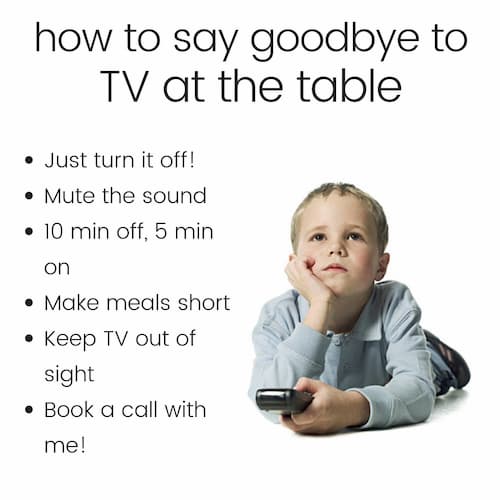
Two Methods for Ending Mealtime Distractions for Picky Eaters
Cold Turkey
-
Just turn it off.
-
Cold turkey. Reading this you might think this is completely impossible, but you might be surprised. I had one tell me her son missed not having the TV on but actually enjoyed eating together and was happy his mom wasn’t on her phone during meals. He ate the same amount as usual.
-
-
Rearrange the eating environment.
-
If your child’s chair is facing the table or if you’re used to eating at the couch, make some changes to get the TV out of sight.
-
Baby Steps
-
Go on mute.
-
Muting the TV or tablet shows is a stepping stone to eventually eliminating it completely. Once your child is comfortable eating with the sound off, you can try turning the entertainment off completely.
-
-
Try 5 minutes off, 5 minutes on.
-
Start the meal without screen time. If your child hasn’t been eating and is struggling to sit, introduce the distraction after 5 minutes. Allow the distraction for 5 minutes and then remove it. Repeat until the meal is over. Gradually increase the initial screen-free duration and then decrease the time with the screen as your child becomes more comfortable eating without it.
-
Recap
Having a distraction like a TV, tablet, or toy at the table is common for picky eaters, children on the autism spectrum, or those with sensory food aversions. These sorts of distractions can make it easier for a child to eat more comfortably. But they don’t address the underlying eating issues and help a child learn to eat new foods.
Homework
Decide which approach – Cold Turkey or Baby Steps – is best for you. Get started with just one change at a time, starting as small as just one meal per day. Once this change is comfortable for at least 3 days, introduce another change. If you’re starting with just one meal, after 3 days add one more meal. Add a meal or a new change one at a time until all meals are distraction-free.


0 Comments