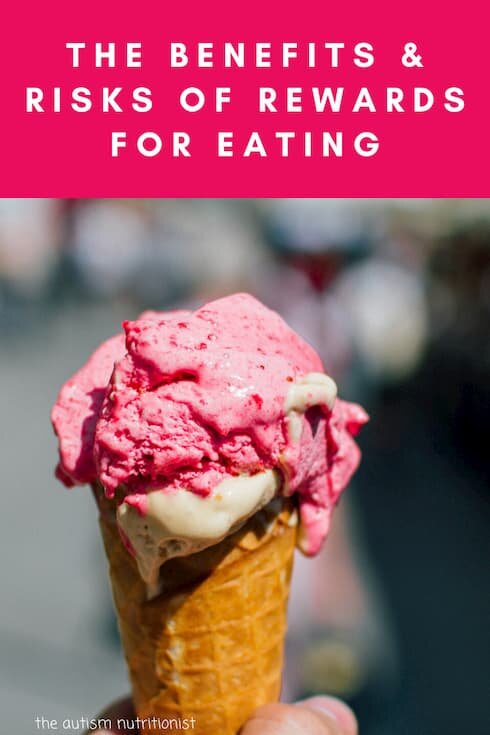
This article discusses the benefits and risks of offering bribes, incentives, and rewards for eating.
“Take one bite and then you can have more macaroni and cheese.”
“You can have dessert if you eat it.”
“If you try the broccoli you’ll get a sticker.”
“We can go to the toy store if you eat well all week.”
Do any of these phrases sound familiar? Maybe you heard them from your parents growing up or maybe they’re phrases you’ve considered with your own kids.
We call this bargaining at the table or offering food bribes or rewards for eating. Though the language and scenario may play out differently, what they all have in common is the use of an incentive to cajole a child to eat certain foods.
I’m often asked by the parents I work with if using this strategy is beneficial or harmful.
My instinct is to say that it’s not my favorite approach. Intuitively, I believe kids should work up to feeling comfortable trying new foods on their terms and should be left alone to eat according to appetite and desire. Yet, the more I work, the more I encounter situations where using this approach seems effective and helpful. Sometimes it seems to be the only approach that actually works.
So rather than rely strictly on my experience and intuition, I dove into the research on using food bribes and rewards for eating with kids. Here we’ll break down:
- what exactly are rewards for eating
- the benefits of food rewards for kids?
- the potential drawbacks of bribing kids to eat
- what you should ultimately do
What are rewards for eating?
Providing eating rewards is a feeding strategy that provides a child with incentives to accomplish desired eating behavior. For example, a child might earn a preferred or highly desired food for eating a certain food or certain amount. Alternatively, kids could be offered non-food rewards such as screen-time or a new toy. Offering rewards for eating is essentially well-intentioned bribing.
What are the benefits of rewards for eating?
Offering a child incentive to eat can get them to do just that. I see parents use food rewards when they suspect a child has a behavioral block to eating particular foods. The ultimate benefit is that you can get your child to eat what or how you want.
Typically when using an eating reward, you’ll see your desired result immediately.
Some studies do suggest that rewarding preschoolers for trying food is associated with their eating more of that food even without an incentive.

What are the potential drawbacks of bribing kids to eat?
Other studies, however, are less reassuring. In 2016, for example, researchers looking at the impact of parents’ feeding practices on young children found that kids who received food rewards for eating what their parents wanted were more likely to be emotional eaters who ate outside of their hunger and fullness signals when they grew up.
Additionally, many of us know from experience that using food rewards like sweets and desserts can decrease a child’s preference for foods they already like and can further increase their preference for the reward food.
So should you offer eating rewards or are eating rewards detrimental?
First of all, I always want to look at the motives behind providing eating rewards. Often this can come from a parent’s wanting to control their child’s intake. But, sometimes, an incentive might be the missing piece that gets the child over the hump to trying new foods. Using non-food rewards can help children overcome their initial resistance to trying a new food. Because trying a new food is the most important determinant in a child’s preference for it, this can be extremely meaningful.
Regardless, we know that frequent exposure to new foods provided without pressure is always effective – even if the effect might not be as immediate.

I avoid it when I can but for anything out of a package, this is the only tactic that produces results beyond kissing and licking. It’s what her behavior therapist and OT used to some effect. I’m glad you covered this because it is controversial and has definite drawbacks.