
This article discusses why taking medicine can be so hard for picky eaters and shares 6 ways to help picky eaters take medicine.
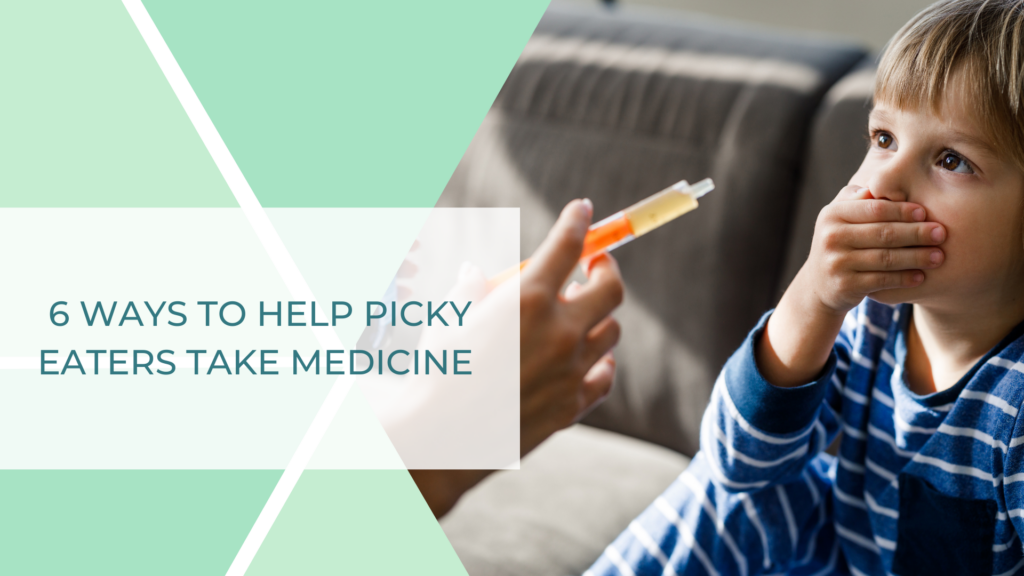
There’s a reason why Mary Poppins suggested a spoonful of sugar to help get the medicine to go down. Taking medicine isn’t fun. It can be especially hard for extremely picky eaters who are naturally hesitant to eat unfamiliar things. If your child has sensory sensitivities, medicine can be even more difficult – creamy liquids, hard pills, chalky dissolvable tablets can all exacerbate sensory difficulties.
Unlike trying novel foods, which is important but not vital, taking medicine can be urgent and non-negotiable. But that doesn’t mean your picky eater is any more likely to do it.
Many parents struggle to get their children and picky eaters to take medicine and look for tips to help their picky eater take medicine with less of a struggle.
See below for our suggestions to help reframe the medicine issue for picky eaters, and help your child accept their remedy more readily, making that pill taste a little less bitter.

6 Ways to Help Picky Eaters Take Medicine
Recognize that medicine is not food
If you have been following along for some time, then you know that I am not a fan of disguising foods, sneaking vegetables into meals, negotiating or offering food rewards. We want to foster feelings of trust and safety in our children when it comes to food and eating and we want the desire to eat to come from them.
But medicine isn’t food. If your child struggles to take medicine, it’s okay to bend some of the usual food rules to get the medicine down. Try things like having them hold their nose, mixing it into preferred foods, and offering rewards.
Validate their feelings
Medicine is tough for everyone – that’s okay. In fact, it’s normal! You can validate your child’s feelings by explaining that you understand how difficult it is.
In recognizing their feelings, you will help them feel less alone in their struggle. Ultimately, yes, they still need to take their medicine, but we understand that it is not fun and we’re right there with them.
Identify the resistance
Getting to the root of your child’s worries and fears can be helpful for finding a solution and better understanding how to help them feel more comfortable.
Try asking open ended questions:
- “Hey, I see you are having a hard time with your medicine. What about this is making you nervous?
- “Why do you think you are having such a big reaction to this?”
Your child’s answer might surprise you and can give you a new direction to make taking the medicine easier.
Highlight the benefits
Sometimes it’s enough to get really clear on the benefits and purpose of medicine, especially if your child is feeling uncomfortable. The thought of relief could be tempting.
You can share with them a time when you had to take medicine. Go through an instance when you were not feeling well, and were having a difficult time taking your medicine – but once you did, you felt so much better.
Show how taking it can be simple. Say something like: “I know that it doesn’t taste good, but it really only lasts for a few seconds and it will help you feel sooo much better. Let’s see how quickly you can take it!”
Offer control
Taking medicine isn’t the same as eating. But some of our go-to meal time tips can still come in handy.
As with eating, offering your child control can have a positive impact.
One of my favorite picky eater phrases can be particularly helpful with medicine struggles. Try asking your child, “what can make this better for you?” This will give your child a sense of control, while also encouraging them to think about how they’re feeling and why.
Offering different types of medications or methods of taking medicine can be particularly helpful.
Try these prompts to give your child a bit of control.
- If you have the option, let them choose the form – as a liquid, pill, gummy or chewable?
- Offer options for delivery: Would they like to take it with a syringe, their favorite tea set, or in their Spiderman mug?
- Would they like it with food? They can chase it with a special drink, wash it down with a cookie, or mix it into a preferred food.
- Ask them where they want to take it. In front of the TV on the couch might feel fun.
- As appropriate, let them decide if they want to do it all on their own or if they want your help
Create positive associations
While taking medicine might not ever feel like a fun activity, there are certainly ways to get playful with it and create positive associations
Maybe have your child role-play being a doctor, and they help their favorite doll or toy take the medicine first. Or maybe each time your child takes their medicine, they get a sticker.certain number of stickers earn them a prize! Some parents even create a treasure chest with fun toys that the child can pick from after taking their medicine.
You can also create positive reinforcements around the benefits of medicine. Every time your child successfully takes their medicine, you can remind them how great it is because it will allow them to go back to their normal activities. “I’m so happy you took your medicine – you’re that much closer to being able to go back to the park and play!” or “How great you took your medicine, that should help your ear ache feel a lot better.” Even if the clinical impacts are not immediate, never underestimate the power of a placebo – even for kids!


0 Comments