
This article discusses 5 ways to get picky eaters excited about cooking, helping even the pickiest of eaters feel more comfortable in the kitchen and around new foods.
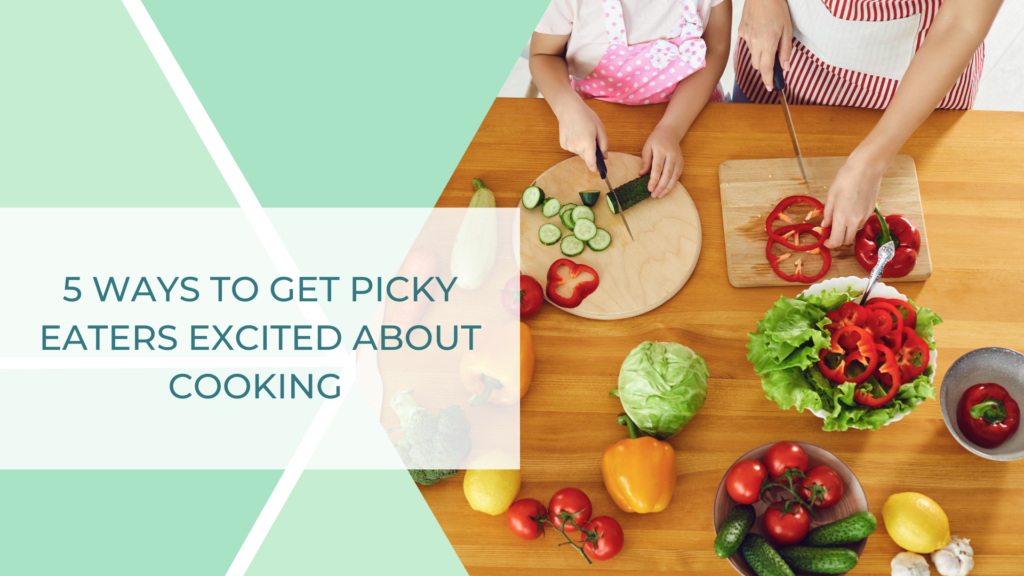
Research shows that children who are regularly involved in cooking are more likely to try novel foods. The hands-on nature of cooking enables children to feel more comfortable and confident around new foods, boosting their willingness to eat them.
Moving food exposures away from meal time, when there is an inherent pressure to eat or taste, can allow children to interact with their food in a way that naturally builds trust and familiarity. Cooking can also help your child feel more in control, and can actually sow the seeds for a more positive relationship with food.
So roll your sleeves up, get creative, and don’t fear a little mess. Offer small, entertaining, and appropriate activities that meet your child where they are at.
Follow our 5 tips to get picky eaters excited about cooking and how you can make it an enjoyable experience for you and for them.

5 Ways to Get Picky Eaters Excited About Cooking
Start At The Grocery Store
Bringing your child to the grocery store is a great way to increase their exposure to a plethora of foods – and see which ones they get excited about.
To boost excitement and engagement, think of different tasks or games that your child can participate in. Ask your child to be a detective, seeing if they can “spy” certain items. Or maybe ask them to pick 3 apples from the bin that looks good to them, or to choose the biggest potato they can find. These activities create a non-threatening opportunity to engage and allow them to interact with food in a way that will leave them excited when they spot that crown of broccoli!
While you are moving through the aisles, it can also be beneficial to engage in a conversation around food. What do they notice? What do broccoli and cauliflower have in common? What green vegetables do they see?
Dialogue around foods in this environment, without the prospect of eating or tasting, can help your child get better acquainted with these foods and can boost their interest in helping with meal prep at home.
Meet Your Child Where They’re At
Meeting your child where they are at and offering roles and opportunities that accommodate their sensitivities is key to them feeling comfortable and having a good time. The goal is to make cooking enjoyable and allow your child to engage with food in a manner that boosts their confidence and comfortability.
Think about your child’s preferences and sensitivities and keep these in mind when creating opportunities for them. For example, if your child is sensitive to scent, give them a job that does not involve “big smells,” (avoid garlic and onions!). Find something more neutral like kneading dough and measuring rice to boil.
If your child is uncomfortable in the kitchen, bring food to a more neutral location like their play area or an outside table.
Start Small
Adjust your expectations about “cooking.” It doesn’t have to be an entire recipe.
Start by giving your child one 1 small task (and we really mean small!). This can be as simple as sprinkling some salt or filling up a cup with water. The important part isn’t the size of their contribution, but that they’re having fun and know that they are playing a role in preparing the food.
Examples of “starter” tasks:
- Washing a specific fruit or veggie
- Passing the salt or spice jar
- Filling a measuring cup up with water
- Passing the bowl/pot/ pan
- Tearing lettuce leaves for a salad
- Watching the timer for when something is ready
- Stirring for 30 seconds
Once your child has mastered basic tasks and feels comfortable in the kitchen, begin to offer more involved opportunities.
Make Them Feel Like A Star
In setting up a cooking opportunity, aim to give your child a role that allows them to feel like they’re really helping.
Offer phrases such as “This is SO hard to stir, I need a little break – can you help me?” or “Hmm I can’t tell what this sauce is missing. Do you want to try it and help me figure out what else it may need?”
You want your child to feel valuable in the kitchen, enabling their self assurance.
Involve All The Senses
We often think about food as a taste-based experience, but food has the potential to engage all of the senses. Touching, seeing, smelling, and listening to food are key components in increasing your child’s comfortability around new foods. When you take taste out of the picture, you can create a more trusting platform to begin engaging with food (eventually increasing their likelihood of tasting it).
Here are a few ways to get your child’s senses involved when cooking:
- Sight: What do certain foods remind you of? Doesn’t broccoli look like a little tree? Walnuts look like little brains! How many red vegetables do you see? I spy something yellow – do you want to guess what it is?
- Touch: Observe the texture of a food. What does it feel like? Is it soft? Hard? Slippery? Bumpy? Does the inside feel like the outside? How does it change when we cook it?
- Scent: What do you smell? Is it sweet? Floral? Strong? How does the smell change when we add ____ to it?
- Sound: What sounds do we hear in the kitchen? Boiling water? Popping sauce? Sizzling chicken? Swoosh of the knife?
If your child is hesitant to engage with food for a sensory reason, it is important to ease into it with less hands-on exposure.
Get Picky Eaters Excited About Cooking – BONUS TIP
Don’t Forget Fun
This one is a must. To create a happy and welcoming atmosphere in the kitchen, we need to make cooking enjoyable and playful. Let kids get messy and experiment with food in a way that feels right to them. Follow their lead and set them up to see how cool and exciting food can be.
Have them mix baking soda with vinegar to form lava; throw a piece of pasta at the wall to see if it sticks (that’s how you know it’s done!); or maybe make it into a game – how many seeds do you think strawberries have? (they have 200!!).
Use food dye to change the color of foods, or use hands to mash or squash food – like avocado for guacamole. The possibilities are endless, and by making cooking into something fun and exciting, your child will have positive associations, increased comfort and confidence, and a greater likelihood of one day eating.
Cooking is a wonderful way to help your picky eater get closer to trying new foods, but it’s just one part of the process. Looking for the whole picture? Grab your FREE guide with my 5-step framework to help your extremely picky eater try new foods.


0 Comments