
“How do you get a kid who won’t try ANYTHING to start? He’ll cook and touch, he just won’t try.”
An autism mom approached me recently with this question.
Can you relate?
Autism and New Foods
Cooking and touching are positive food experiences that can work up to eating, but of course, touching only just doesn’t cut it when you’re trying to improve your picky eater’s diet.
One of the best tips for introducing new foods to children with autism is something I refer to “first this…then that.”
“First this…then that” is a behavioral technique that can be very effective for autistic kids. It’s very clear and can help with other behaviors at home or in the classroom. It can even be helpful for managing mealtime behaviors.
Think of the “first this…then that” technique as a bite for a bite. This is how you do it: first, offer a bite of a new food. Then, offer a bite of a favorite food. First carrots, then rice. Simple!
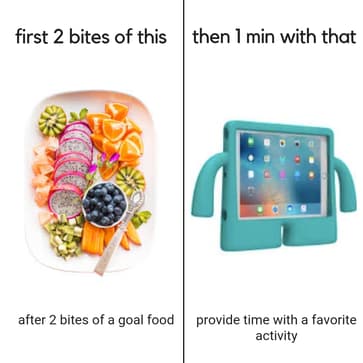
You can also exchange a bite for access to a favorite activity. The activity should be highly desired by your child and after eating is the only time he should gain access to it.
The eventual goal to help your child try new foods and expand their diets is to increase the number of goal food bites a while still offering just one taste of the preferred food. So first, three carrot bites, then a bite of rice.
Have you tried anything like this?
Positive Reinforcement: How to Get Your Autistic Child to Try New Foods
The “first this…then that” idea stems from something known as the Premack Principle. The theory is that more likely (high probability) behaviors can be used to reinforce less likely behaviors. More likely behaviors are the ones that your child loves to do and frequently chooses. For food, the “more likely behavior” is the food your child always accepts and loves to eat.
As always, when using the Premack Principle or introducing new foods in any way, try to make the experience as pleasant and fun as possible. It’s not a battle! If your child isn’t feeling up to it, put the activity on hold and try another day.
Okay, so what exactly does this look like at home?

How to Use Positive Reinforcement to Help Your Autistic Child Learn to Eat New Foods
Follow these simple steps for using “first this…then that” to introduce new foods to picky eaters with autism
-
Select a “reinforcer.” This is a favorite food that your selective eater will always eat and highly desires. Alternatively you can select an activity that your child loves. Pick something s/he chooses to do whenever there is free time. The key is to pick something that your child highly desires and then to restrict access so s/he only receives this food or activity AFTER eating the goal food.
-
Choose a new food to introduce. Select a food that makes sense for your family – a food that you frequently eat or from a food group that your child’s diet is lacking. (Don’t pick broccoli if no one ever eats broccoli!)
-
Offer a bite for a bite. For each bite of new food, immediately provide a bite of favorite food (this is also positive reinforcement). If using an activity, set an amount of time your child will have access to the activity (ie 90 seconds of tablet time).
-
Include a visual. A fun way to communicate with your child while increasing his/her sense of control and involvement is to place all of the alternating bites on his/her plate. You can also include visual instructions like below.
-
Make gradual changes. Once this the bite for a bite model is comfortable, gradually increase the ratio of new food to favorite food (offer two bites of the new food for one bite of the favorite food).
-
Take baby steps. If eating a new food feels too far away, you can work up to it by first touching, smelling, licking, or kissing

AND
If you’re looking for support on putting this whole “first this…then that” principle in action, check out my Autism Nutrition Program where receive specialized counseling to help your child on the autism spectrum expand his diet and try healthier foods.
To recap
Offering a bite of something that your child loves after he/she takes a bite of a new food is one way you can encourage a picky eater with autism to try new foods. A bite for a bite. The preferred food will reinforce the goal behavior and also provides positive feedback for accomplishing the goal of eating new foods.
As with all efforts to expand picky eating, go slowly using just one food at a time, keep the pressure low, and have some fun.
Homework
Now that you’ve got this new picky eating trick under your belt I want you to give it a try. “First this…then that” works well for snacks, so get started using the tips above. Report back here in the comments or join the conversation in my Nutrition for Autism Facebook group.


0 Comments